Draw the complete material path
A robotic painting cell usually depends on equipment outside the robot’s immediate work envelope. Incoming parts may be conveyed, indexed or manually loaded. Coating may be mixed and conditioned in a separate area. Exhaust systems, flash-off zones, ovens and inspection stations impose their own requirements. Draw these connections before assigning responsibility for individual controllers.
For each interface, identify what crosses the boundary: a part, coating material, energy, air, data or an authorization to proceed. Specify the required condition at transfer. A conveyor can present a part mechanically while the recipe identity is missing. A paint unit can report ready while the wrong material remains in a line. Integration must resolve those conditions rather than treating physical availability as sufficient permission.
Make operating states explicit
Describe the sequence in states such as idle, ready, loading, applying, clearing and faulted, using names appropriate to the system. Define the conditions for entering and leaving each state. The production controller, robot and material supply unit should agree on what a signal means and whether it describes a command, a confirmation or a maintained condition.
A robust handshake distinguishes “request received” from “operation complete.” Include timeouts, contradictory signals and communication loss in the design. Part identity and recipe revision must remain associated through interruptions. After a controller restart, the system should not assume that a previously issued command completed or that the material in the applicator still matches the next scheduled part.
| Boundary | Production information | Abnormal condition to test |
|---|---|---|
| Part presentation | Identity, position and fixture confirmation | Missing, mislocated or unidentified part |
| Material delivery | Material identity and delivery readiness | Loss of supply or incomplete changeover |
| Application | Recipe, path and completion status | Interrupted cycle or mismatched revision |
| Inspection | Result, confidence and disposition | Missing result or held part |
Separate safety from ordinary sequencing
A normal PLC handshake is not automatically a safety function. Risk assessment determines the protective measures and the required performance of safety-related control functions. ISO 12100 provides a framework for machinery risk assessment and risk reduction. ISO 10218 addresses industrial robot safety, while ISO 13849-1 and IEC 62061 concern safety-related control systems. Use the applicable editions and the legal framework relevant to the installation.
Painting can introduce fire, explosion, exposure and electrostatic hazards alongside mechanical motion. In European settings, ATEX requirements may be relevant to equipment selection and workplace arrangements; applicability depends on the assessed environment. EN 16985 addresses safety requirements for spray booths for organic coating material. These references identify areas for competent assessment, not a checklist that makes a cell compliant by citation alone.
Plan changeovers and recovery
Color change, material change and cleaning need defined sequences and acceptance conditions. Identify where residual material can remain and how the system establishes readiness for the next product. Cleaning media, waste handling and incompatible materials introduce their own constraints. Follow coating and equipment instructions rather than improvising a flush sequence from a generic description.
Recovery from interruption is equally important. A part stopped midway through application may have uneven film build or an exceeded process interval. It should not automatically rejoin production as an untouched part. Define how operators identify its state, isolate it if necessary and obtain an authorized disposition. Recovery instructions should also address loss of power, loss of air, ventilation faults and interrupted curing.
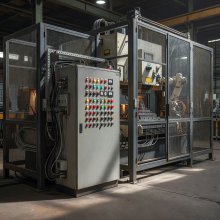
Signals need definitions
Control hardware is only the physical layer. The depicted cabinet does not establish the meaning or safety integrity of a production signal.
Commission against agreed evidence
Factory and site acceptance activities should trace back to requirements. Demonstrate representative parts and recipes, not only an empty robot cycle. Test identity tracking, actual material changeover, inspection association and abnormal conditions using safe, planned procedures. Record configuration versions so that a successful test can be connected to the system that was actually delivered.
Define responsibilities between the manufacturer, integrator, coating supplier and site operator. Training, maintenance access, spare parts and document control are part of readiness. A system that can paint a trial part is not necessarily ready for sustained operation with different operators, material batches and planned maintenance interventions.
Keep records proportionate and usable
Collect the information needed to explain the process: part or batch identity, recipe revision, material identity, relevant operating conditions, faults and inspection disposition. More data is not automatically better. Establish units, timestamps, retention, access control and the meaning of missing values. A dashboard that displays commands as if they were measured conditions can create false confidence.
Finally, place changes under review. New substrates, coating formulations, fixtures, firmware or inspection methods may alter an established process. Assess the impact and repeat appropriate validation before treating previous evidence as transferable. Use the enquiry worksheet to organize an integration question around a clearly defined boundary and observed condition.