Start with the service requirement
A preparation route begins with the duty of the finished part. An indoor enclosure, an outdoor steel structure and a molded polymer housing face different exposure conditions. Identify corrosion protection, appearance, chemical resistance and mechanical requirements before choosing cleaning or pretreatment. The coating supplier’s technical data sheet is a starting point, not a substitute for checking the complete substrate and coating combination.
Record what arrives from the previous operation. Steel may carry oil, oxide or weld residue. Aluminum can bring machining fluids and a changing oxide surface. Molded plastics may contain release agents or additives that affect wetting. Two parts with the same drawing can therefore present different coating conditions. A robot can reproduce a trajectory across those parts without correcting their different surface energies or contamination histories.
Define an acceptable incoming surface
Write an acceptance rule that can be checked at the process boundary. “Clean” is not specific enough. Depending on the specification, evidence might include a visual preparation grade, an agreed surface profile range, a contamination test or a documented pretreatment process. ISO 8501-1 addresses visual assessment of steel surface preparation. The ISO 8502 series covers tests for assessing surface cleanliness, while ISO 8503 addresses roughness characteristics of blast-cleaned steel substrates.
These references are not interchangeable, and a visual grade alone does not demonstrate the absence of soluble salts. Use the relevant test method and the project specification to decide what is measured, where samples are taken and what happens after a failed result. AMPP also publishes surface-preparation standards; check the specified document and edition rather than assuming that different designations are equivalent.
Separate cleaning from pretreatment
Cleaning removes unwanted material. Pretreatment changes the surface to support the required coating system. They may sit in the same line, but they have different purposes and failure modes. A conversion treatment cannot reliably compensate for oil that remains underneath it. Similarly, an aggressive cleaning step may damage a sensitive substrate or leave residues if rinsing is inadequate.
For wet processes, describe bath condition, contact time, temperature, rinsing and drying as controlled operations. For abrasive preparation, consider abrasive condition, profile, dust removal and access to recesses. For plastics, any activation method needs material-specific validation. Do not infer compatibility from the fact that a process works on a visually similar part.
| Operation | What it addresses | What still needs checking |
|---|---|---|
| Degreasing | Oils and handling contamination | Residue, wetting and substrate compatibility |
| Abrasive cleaning | Oxide removal and surface profile | Dust, soluble contamination and profile suitability |
| Conversion pretreatment | A specified surface chemistry | Bath control, coverage and compatibility |
| Drying | Residual water or process liquid | Trapped liquid, temperature and recontamination |
Control the interval before painting
The period between preparation and application is part of the process. Humidity, airborne contamination, handling and storage can change a prepared surface. Establish a permitted route and exposure interval based on the coating system and validated operating conditions. Check surface temperature and condensation risk where relevant; ambient temperature alone does not describe the state of the part.
Fixtures deserve equal attention. Their contact points determine masking, accessibility and, for electrostatic application, the grounding path. Accumulated coating can change contact resistance and part location. A fixture that holds a part securely may still conceal a critical surface or collect liquid that later drains into fresh paint. Define cleaning and inspection of fixtures as routine operations rather than occasional recovery work.
Handling is a process step
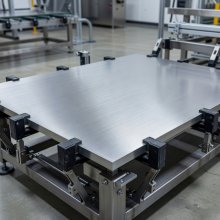
Gloves, racks and packaging can introduce contamination after cleaning. The depicted fixture illustrates part support; its suitability depends on the actual process.
Connect preparation to downstream evidence
When adhesion fails, do not immediately adjust the robot program. Trace the lot, cleaning conditions, pretreatment records, storage interval and cure history. The same visible defect can arise from several causes. Preserve a sample and describe the failure location: within the coating, between coats or at the substrate interface. This distinction helps structure an investigation without prematurely assigning a cause.
Qualification panels are useful only when their substrate, preparation and exposure represent the production condition being assessed. A flat witness panel may not reproduce liquid retention in a folded component. Document that limitation. Use trials to establish a process window, then decide which incoming checks provide meaningful evidence that production remains inside it.
The next task is to turn an acceptable surface into a controlled deposit. Continue to spray control with a defined substrate condition rather than an assumed one.